
Gravel on an endurance bike
How an endurance bike can handle gravel roads too: tyre clearance, vibration damping, tyre choice and practical tips for mixed tarmac and dirt rides.

When the line between tarmac and dirt fades away
Endurance meets gravel
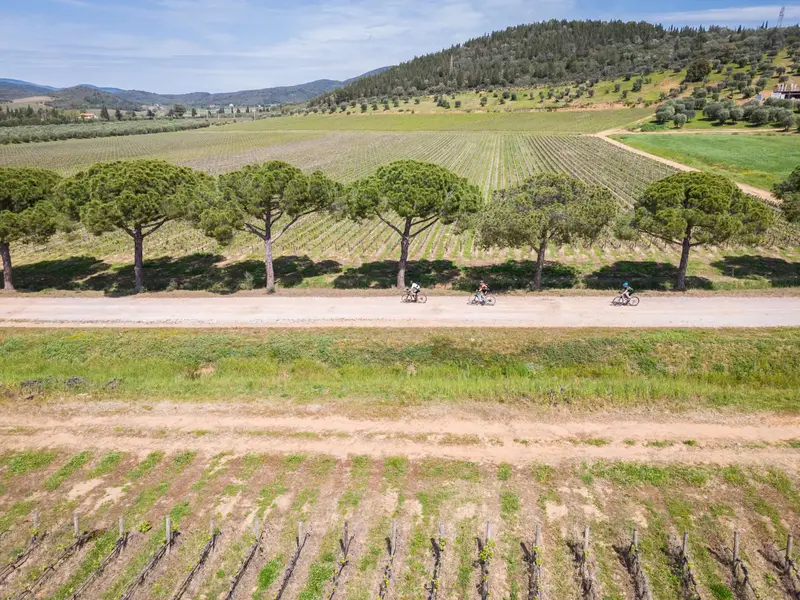
Who said you need a dedicated bike to ride gravel? After months of testing and thousands of kilometres on Tuscany’s white roads, I can tell you that a well set-up endurance bike can be a reliable companion on gravel too. Mind you, I’m not talking about technical singletrack or mountain-bike descents, but about that great network of unpaved roads that makes Tuscany unique.
The secret is in the clearance
What makes modern endurance bikes special is their versatility. With clearance for tyres up to 35-38 mm, they become true all-road bikes. That’s what opens up so many possibilities: you can go from a fast ride on tarmac to an adventure on white roads just by changing tyres.
I have experienced it myself many times, most recently on my trip to Sardinia this winter. After a tyre cut, I fitted a Pirelli Cinturato 700×35 on the Trek Domane to deal with rough roads. It was the right choice: it let me carry on and ride the bumpy roads without problems, and gave me the freedom to leave the tarmac and head off-road.
Something similar happened at the last North Cape 4000 where, after cutting a second road tyre, I ended up fitting a 35 mm gravel tyre on the Giant Defy. I prefer a wide tyre even when I’m not riding gravel, whenever I’m in places where the tarmac isn’t great, which in Italy, let’s be honest, is most places.
Technology for comfort
What really sets modern endurance bikes apart is how well they absorb vibration. We’re not talking about frames with a bit of flex, but real systems engineered for comfort. Trek’s IsoSpeed, for example, is a real revolution: it lets the seat tube flex independently from the rest of the frame, absorbing shocks without losing pedalling efficiency.
Giant’s D-Fuse takes a different but equally effective approach. The D-shaped seatpost and the dedicated handlebar work together to filter vibrations before they reach you. I tested it on the Defy, and you really feel the difference, especially after several hours on dirt roads. These systems were designed for comfort on the road, but they turn out to be great allies on dirt. They don’t replace a real gravel bike, but they make endurance bikes surprisingly capable off the tarmac.
What L’Eroica taught me
Riding vintage bikes at L’Eroica taught me something: you don’t need a specialised bike to enjoy dirt roads. I still remember my first Eroica, on 25 mm tyres, riding down steep dirt descents with old-style brakes. How brave the riders of the past were, on roads that had never seen tarmac, with bikes like those! After riding vintage bikes at many events, I can tell you a modern bike has big advantages, especially when it comes to braking. Of course you need a mixed riding technique, part road and part off-road, and you need to read the terrain well.
Speed and comfort: a winning compromise
With 35 or 38 mm tyres on an endurance bike you get a great balance between speed and comfort. Sure, on very rough ground you won’t have the confidence a gravel bike gives you, but on classic Tuscan white roads? Your riding technique makes more difference than the bike.
Choosing tyres: the key element
The real key to turning your endurance bike into a gravel-road machine is the tyres. A 35 mm tyre with a semi-slick or light tread can work wonders: it keeps you fast on tarmac without losing grip on dirt.
One piece of advice I always give is to check the tyre clearance yourself. Even if the manufacturer states a maximum size, it’s always worth making sure there is still some space between frame and tyre. I say it from experience: when the mud gets sticky (and I confess it has happened to me more than once), you really don’t want to get stuck in the middle of nowhere.
When endurance becomes gravel
The beauty of riding an endurance bike on gravel is that you don’t have to choose. You can start on tarmac, take a detour on a dirt road and get back on the main road without ever feeling out of place. That versatility is what makes these bikes so special.
A few practical tips:
- Choose tyres with a semi-slick or light tread
- Run slightly lower pressures than you would on the road
- Start with easy dirt roads to build confidence
- Make the most of your bike’s vibration-damping technology
- Check the frame regularly after hard rides
- Invest in good bar tape for extra comfort
Conclusion
Modern endurance bikes have little to envy their gravel cousins on Tuscan white roads. With the right setup and a bit of technique, they can give you great rides on both tarmac and dirt. The key is to know the bike’s limits and respect them, without expecting an endurance bike to become a mountain bike.
PS: stay tuned, because I will soon tell you about my experience with the new Trek Domane, a bike that is redefining versatility on two wheels. Believe me, there’s a lot to say about it.